
What Makes a GPS Line Painter Superior to Laser-Guided Systems


Ever had that moment when you’re halfway through setting up a soccer field and realize the lines just aren’t lining up? Or you spend half your morning fiddling with equipment instead of actually painting?
Field crews, athletic directors, and park managers know the struggle. The season is packed, the clock is ticking, and every extra step in setup means less time for everything else you need to do. And that’s where the conversation usually turns to technology.
Over the years, a lot of folks have leaned on laser-guided systems to help with line painting. They were a big step up from strings and stakes. But here’s the truth: just because something was once the best option doesn’t mean it still is.
Today, more and more crews are switching to SWOZI USA’s GPS line painters—and for good reason. And the difference isn’t just bells and whistles. It’s about fewer headaches, faster setups, and lines you can trust every single time.
Let’s break it down.
The Reality of Field Marking
Field marking is one of those jobs everyone notices when it’s done wrong but rarely appreciates when it’s done right. Straight lines, perfect measurements, correct placement. It all matters, whether it’s a championship game or just a Saturday morning youth league.
But here’s the thing:
You’re not just painting one field. You’re often juggling multiple fields, sometimes across different sports.
Weather doesn’t wait for you. Rain washes out lines. Sun fades paint.
Staff and time are limited. Crews have a lot more to manage than chalk and paint.
Laser-guided line painting systems helped for a while. They cut down on strings, chalk reels, and, sure, guesswork, too. But they also brought their own set of issues—things like bulky base stations, line-of-sight limitations, and more time spent on setup than you’d like.
Enter GPS line painter.
Why a GPS Line Painter Changes the Game

So what makes a GPS line painter the smarter choice? Let’s look at what really matters on the job.
1. No Base Stations to Mess With
Laser-guided systems require a fixed base station. And that means hauling extra equipment, setting it up in the right spot, making sure nothing blocks the signal—and starting over if something shifts.
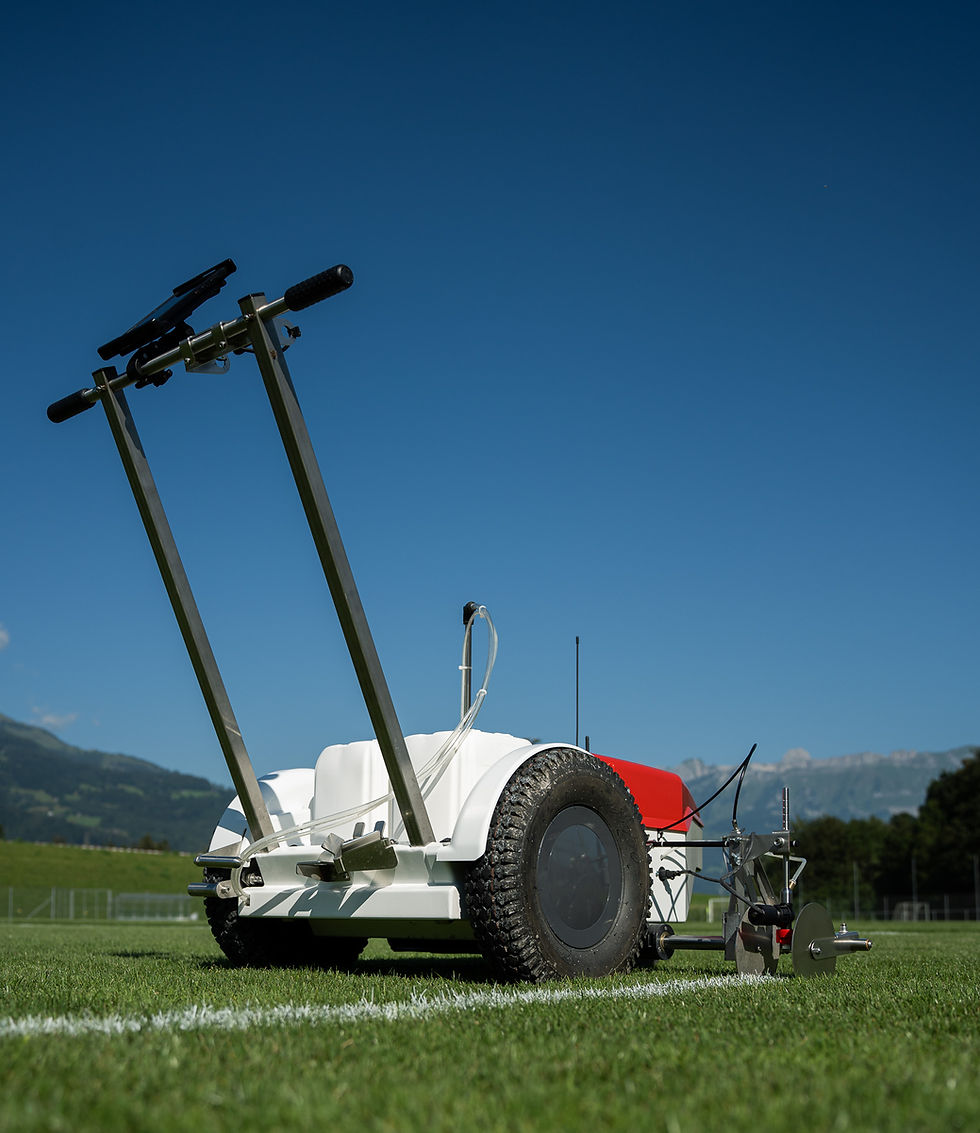
But GPS skips all that. You wheel your painter onto the field, load your layout, and go.
2. No Line-of-Sight Problems
Lasers need clear, uninterrupted paths. So if a truck parks in the wrong place, if trees are nearby, or if players start warming up early—good luck.
A GPS line painter doesn’t care about obstacles. The satellite connection is steady, so you stay on track no matter what’s around you.
3. Faster Setups, Fewer Crew
With GPS, one person can set up and paint a field in a fraction of the time. Yes, so just imagine lining five fields before lunch with just one staff member. And that’s not a stretch—that’s happening right now for schools and parks using SWOZI USA.
4. Precision Every Time
We’re talking accuracy down to the inch. No drift, no “close enough,” no arguing over measurements. Whether it’s football hash marks or soccer penalty boxes, the GPS system nails it consistently.
5. Flexibility Across Sports
Switching from a lacrosse field to a football field? No problem. Load the layout, press go, and let the machine adjust. You don’t need to remeasure everything from scratch.
GPS Line Painter vs. Laser-Guided Systems: Side-by-Side
Here’s the quick comparison field managers have been asking for:
Feature | GPS Line Painter | Laser-Guided System |
Setup Time | 5–10 minutes | 30+ minutes (with base station setup) |
Crew Needed | 1 person | 2–3 people |
Accuracy | Inch-level precision | Good, but can drift with obstructions |
Line-of-Sight Required | No | Yes |
Flexibility | Easy to switch sports/fields | Limited—requires manual adjustments |
Equipment | Compact painter unit with GPS | Painter + base station + tripods |
When you look at it this way, it’s easy to see why the GPS field painter is becoming the go-to choice.
Real-World Scenarios: What Crews Could Expect After Switching to GPS Line Painter
We’re not here to spin tall tales—every program and maintenance crew runs a little differently. But here’s what might happen in your world when making the jump from a laser-guided system to a GPS line painter.
→ The Saturday Rush Problem
Picture this: It’s game day weekend, and you’ve got three soccer fields to set up before 10 a.m. With laser systems, you’re dealing with base stations, manual alignment, and double-checking every corner.
With GPS, you could simply roll straight onto the field, pull up your saved layout, and paint lines with pinpoint accuracy—no extra hands needed.
→ The “Lost Line” Dilemma
Ever had lines fade after a heavy rain or reseeding? Laser systems mean re-setting and re-squaring the field—time you don’t have. But with GPS? The field layout is saved digitally, so it’s just a matter of pulling up the file and repainting exactly where the lines need to be.
→ The Labor Crunch
A short crew is a common headache, especially during peak season. Well, not with GPS. One person could manage multiple fields in a morning—something that usually takes a team of two or three with lasers. That only means fewer overtime hours and less stress on an already thin staff.
These simply highlight what GPS line painters are designed to do: cut down wasted effort, save time, and give you accuracy you can trust.
The Cost of Sticking with Old Tech
Let’s face it: holding onto laser-guided systems is like still using flip phones when everyone else has smartphones. Sure, they still work, but they’re clunky, limited, and take more effort than they should.
Plus, the hidden costs add up fast:
More crew hours spent setting up and troubleshooting.
More repainting when lines drift or fade.
More scheduling stress when weather or events throw you off.
Meanwhile, a GPS line marking machine pays for itself in time and labor savings alone.
GPS Line Painter Isn’t the Future—It’s the Now

Sometimes people frame GPS as “the future of field marking.” But the truth is, it’s already here. Parks, schools, and pro facilities across the country are already relying on GPS every week.
And it’s not about fancy features—it’s about getting fields done right, fast, and with less hassle. That’s what makes a GPS line painter superior.
Why SWOZI USA Leads the Pack
There are a few GPS systems out there, but here’s why crews trust SWOZI USA:
✔️ User-friendly software—load templates with ease.
✔️ Compact design—easy to transport and store.
✔️ Reliable accuracy—inch-perfect, every time.
✔️ Support that understands fields—we’re not just tech folks, we know sports surfaces.
We built SWOZI USA with field crews in mind. No fluff, no gimmicks—just a smarter way to mark.
Wrapping It Up
If you’ve ever wrestled with base stations, wasted time on setups, or had to repaint because of line drift, you already know why it’s time to move past lasers.
A GPS line painter isn’t just a nicer tool—it’s a better way to work. Less stress, fewer people, more fields done in less time, and accuracy you can count on.
And at the end of the day, that’s what matters: getting the job done right, so players, coaches, and communities get the best fields possible.
Ready to see how it works in real life?
Want to compare GPS vs. lasers on your own fields?
Schedule a demo with SWOZI USA today. We’ll show you exactly how a GPS line painter saves time, cuts labor, and takes the headache out of field marking.
Because you’ve got better things to do than fight with equipment.


What's the best way to get started with makes gps? Looking at it differently, just starred this in my browser. To build on that, a visual breakdown of makes gps would make this even more accessible. Along those lines, i find zero fault with the reasoning about makes gps. That said, this gave me a whole new appreciation for makes gps https://www.abs.gov.au/statistics/economy/finance/household-expenditure-survey/latest-release From another angle, the frustration with makes gps that you described is so relatable. Separately, your commitment to makes gps really shows in this blog post. What's also worth noting is this is getting a dedicated bookmark folder. Adding to that, this is genuinely practical, can't thank you enough. Now that I think about it, the historical context…
This is a really interesting perspective on the topic. I great overview appreciate the effort that went into writing this article, and https://en.wikipedia.org/wiki/Blog I think more people should be aware of these points.