
Robotic Field Painters Versus Traditional Line Marking Methods

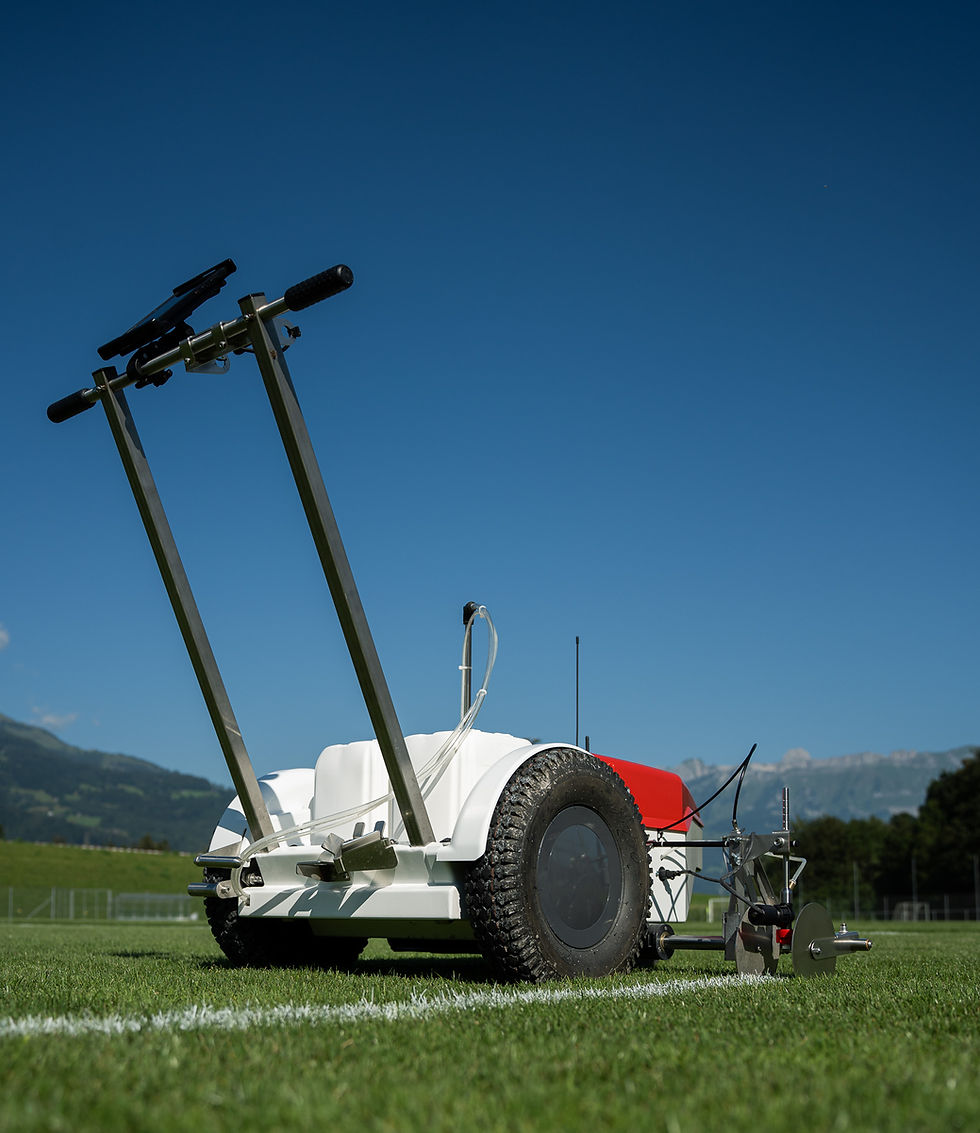
Let’s face it—marking sports fields the old-fashioned way can be downright exhausting.
Stretching strings, checking measurements repeatedly, rolling paint, and pacing back and forth across the turf? It sure is easy to spend hours just trying to get a single field right.
And if the weather doesn’t cooperate? That’s when the frustration really kicks in. So, for facilities juggling tight schedules, seasonal staff, and the pressure to have perfectly lined fields, traditional line marking methods have obvious limits.
And that’s where SWOZI USA’s robotic field painters come in. They combine speed, accuracy, and ease-of-use in ways manual methods simply can’t match.
Traditional Line Marking Methods: What You’re Up Against
Before diving into robotics, let’s quickly break down the classic approaches most crews still use:
String Lines
Accuracy: Depends entirely on human measurement. Small miscalculations can also quickly turn into crooked or uneven lines.
Time: Setting up a regulation soccer or football field? Well.. count on at least 2–3 hours for a small crew.
Labor: Typically two or more people are needed to measure, stretch, and paint.
Pain Points: Tripping over tape, broken tools, and battling wind or uneven surfaces.
Aerosol or Chalk Spray
Accuracy: Quick for temporary lines, but fades fast and overspray is common here.
Time: Decent for small jobs, yet multiple passes are often necessary for lasting lines.
Labor: One person can do it, but maintaining straight, consistent lines over a full field? Challenging.
Pain Points: Messy hands, constant bending, inconsistent line width.
Walk-Behind Field Painters
Accuracy: Yes, it is better than hand-sprayed lines but still relies on operator skill.
Time: Faster than aerosol, yes, though long fields take repeated passes.
Labor: One person can manage it, but fatigue sets in quickly.
Pain Points: Heavy, hard to transport, uneven paint application, and tricky storage.
Of course, these methods work—but they require effort, patience, and time. And when precision matters, that effort doesn’t always pay off.
Robotic Field Painters: The Smarter Alternative

Now imagine a small, autonomous machine that can read a digital layout, calculate its path, and paint straight, regulation-accurate lines—without anyone pushing a roller or adjusting strings.
That’s a GPS-guided painting in action.
How Robotic Field Painters Change the Game
Save Time: A single operator can do what once took an entire crew, cutting prep time dramatically.
Pinpoint Accuracy: GPS navigation ensures every sideline, hash mark, and goal box is exactly where it should be.
Consistency: Lines are uniform across all fields—no fatigue or human error to worry about.
Labor Efficiency: One person can oversee multiple fields with minimal effort.
It’s a bit like swapping a typewriter for a modern computer—same task, but faster, cleaner, and less stressful.
Comparing Metrics: Traditional vs. Robotic Field Painters
Here’s a simple snapshot showing how traditional methods stack up against robotic field painters:
Feature / Metric | String Lines | Aerosol Spray | Walk-Behind Painter | Robotic Field Painters |
Accuracy | Moderate | Low | Moderate-High | High |
Time per Field | 2–3 hrs | 1–2 hrs | 1.5–2 hrs | 30–60 min |
Labor Required | 2–3 staff | 1–2 staff | 1 staff | 1 staff |
Setup & Cleanup | High | Low | Moderate | Minimal |
Consistency Across Fields | Moderate | Low | Moderate | High |
Paint Usage | Standard | Wasteful | Standard | Optimized |
Looking at this table, it’s clear that robotic field painters offer faster turnaround, reduced labor, and more consistent results.
How Crews Could Benefit: Realistic Robotic Field Painters Scenarios
Every facility is different, but here are practical ways a robotic field painter can make a difference:
→ Game Day Prep: One operator could actually prep three soccer fields for a weekend tournament in the same time it used to take a crew to do one manually.
→ Multi-Sport Facilities: Paint football in the morning, lacrosse in the afternoon—switching layouts digitally, no re-measuring required.
→ Youth & Practice Fields: Adjusting boundaries for smaller goals or practice grids is as simple as dragging and dropping a layout on a tablet.
→ Labor Shortages: Only one experienced staff member? No problem. It can cover more ground, freeing others for maintenance or setup tasks.
These are simply realistic improvements that show how automation helps crews work smarter, not harder.
Why Precision Matters: Beyond Just Straight Lines

Accuracy isn’t just about aesthetics—precision lines have real-world impacts.
Regulation Compliance: Even a few inches off can violate rules and frustrate players or referees.
Professional Appearance: Clean, straight lines signal a well-maintained facility and reflect positively on your team.
Repeatable Layouts: Digital layouts make repainting after weather events or off-season maintenance fast and simple.
In other words, robotic field painters support higher standards across every field.
Bonus: Additional Benefits of Robotic Field Painters
Reduced Material Waste: GPS guidance ensures paint is placed exactly where it belongs.
Quicker Staff Training: Seasonal or new staff can learn the system in hours instead of days.
Easy Portability & Storage: Modern robots are compact, lightweight, and simple to store.
Real-Time Progress Tracking: Monitor jobs from your tablet or phone while handling other prep tasks.
It’s like having an extra pair of hands—except this one never tires or makes mistakes.
Final Thoughts
Old-school methods have their place, but the reality is clear: sports facilities are busier than ever, staff availability fluctuates, and expectations for professional-grade fields continue to rise.
Robotic field painters aren’t just a “nice-to-have” gadget—they’re a practical investment in efficiency, accuracy, and long-term operational success.
Ready to Try It Yourself?
Stop imagining perfectly lined fields and see them in action.
From reducing labor hours to achieving regulation-perfect lines in record time, you’ll wonder how your team ever managed without one.
Less stress. Fewer mistakes. Perfectly lined fields—every time.


This was such an insightful read, especially for someone who has been involved in the robotic field for quite some time now. I completely agree that the depth of information presented here really justifies sharing it widely. It's precisely the kind of resource that can benefit many others. It got me thinking about how we measure success in this area https://www.scamwatch.gov.au/ While the post covers a lot of excellent ground, I wonder if a section on evaluating progress specifically within the robotic field could be a valuable addition. For instance, I've often struggled with quantifying the improvements we make; it's not always a straightforward metric. How do you typically validate what truly works when implementing new robotic solutions in the…
Hats off for caring enough to write so thoroughly about the robotic field; this is genuinely valuable information that I'll definitely be saving and revisiting. It’s refreshing to see such a detailed breakdown. I’ve found that my own network has expanded significantly precisely because of how I've tried to approach this area, sharing insights and learning from others https://www.esafety.gov.au/ It truly makes a difference when content is this well-researched and presented. Your approach to explaining the nuances is what quality content about the robotic field looks like, for real. I'm curious if you would ever consider delving even deeper with a series exploring more advanced applications or perhaps the future trajectory of these technologies. It’s a fascinating subject, and your…
This overview is fantastic, the kind you immediately want to share with colleagues because it cuts through the noise so effectively. You've really captured the essence of robotic field painting, and frankly, it's a topic many get wrong, but you've absolutely nailed it here with such practical, actionable insights. I particularly appreciated the detailed comparison; it’s incredibly helpful for understanding the real-world implications https://www.aic.gov.au/ Honestly, seeing how these robotic systems handle the nuances of different surfaces and weather conditions, as you described, is quite eye-opening. I was wondering, what do you think has been the most contentious point when discussing robotic field painting in professional circles, perhaps regarding initial investment or long-term maintenance needs? It's a subject that sparks a…